Chapter 0: The Best Route
A while ago I lost my phone, I forgot it in the tram coming home from work. After a confusing call with the tram driver, who apparently had found my phone and picked up the call, I knew that I would get it back from the lost and found services. What I did not know is that it was going to take two weeks. This meant spending two weeks without my smartphone. Of course, I could have taken one of my friends or family members up on the offer of using the phones they had stored up in unopened cabinet drawers over the years. However, I thought it would be good to see how I would fare without a smartphone.
But this is not a story of how we should get rid of our smartphones. It is not even a story of how I tried explaining to the front desk worker at the university that I did have a phone, it was just not a smartphone. It is the story that started with a drive to my sister’s house when I went to visit my baby niece.
I got used to preparing for things without a smartphone in those few weeks because I wanted to do it right. I just didn’t listen to music on the go, I called with my traveling girlfriend over Facetime on my laptop and I borrowed an analog camera to take pictures with. All overly dramatic and romanticised, but let’s call it healthy hypothetical nostalgia to a time in which I did not actually live. This new challenge of driving to my sister across the country - we’re talking Netherlands here, so that means a two-hour drive - meant that I found myself writing directions out on a sticky note to put on the dashboard of my car.
There I was, sitting at home with my laptop to write out instructions which were given to me by Google Maps so I could find my way to my sister’s house.
On the one hand, this seemed perfectly obvious to me as a course of action. Of course I would give over this task to the designated technology. I did not even have a map of where I needed to go, and even if I did I would not know how long it would take me to get there at all. This would not necessarily be a big problem, but it would mean that I would probably leave an hour early to not be late for lunch. It would also simply be expected of me to supply them with an estimated time of arrival when I left, something I would not be able to give navigating on my hypothetical route on my non-existent physical map. And so, I sat there doing the writing out of instructions given to me by my computer. By my own choice, but not completely so.
When I started opening up this conversation more, is when I realised how truly ubiquitous navigational apps - specifically Google Maps - are in my surroundings. We use computational aid for almost all navigation, even to drive the same route that we drive every day (“what if there is construction work I don’t know about?”), to go to a friend’s house (“what if I do take a wrong turn and they are left there waiting for me?”), even for leisurely trips to the beach (“how else would we get to the spot with the best reviewed beach on the coast?”). Not only that, but we also expect others to do the same. When I am not using Google Maps, I feel like this is a situation of which I needed to inform whoever I am meeting so they know that I am unsure of my exact time of arrival.
All in all, we are completely addicted to Google Maps choosing the best route for us. Even if it is not actually defined - anywhere - what “best route” means.
There is a lot of questions I have from a lot of angles. For a while I had difficulty navigating them (pun not intended, it is very hard to write about this without accidentally running into a pun every now and then). What helped me in this, was to stay close to the actual technologies used. To understand our relation to navigational apps these days, we have to understand our relation to the parts that make up the whole. That is my opinion, at least. Below you can find a - very general - sketch of the different technologies surrounding the whole.
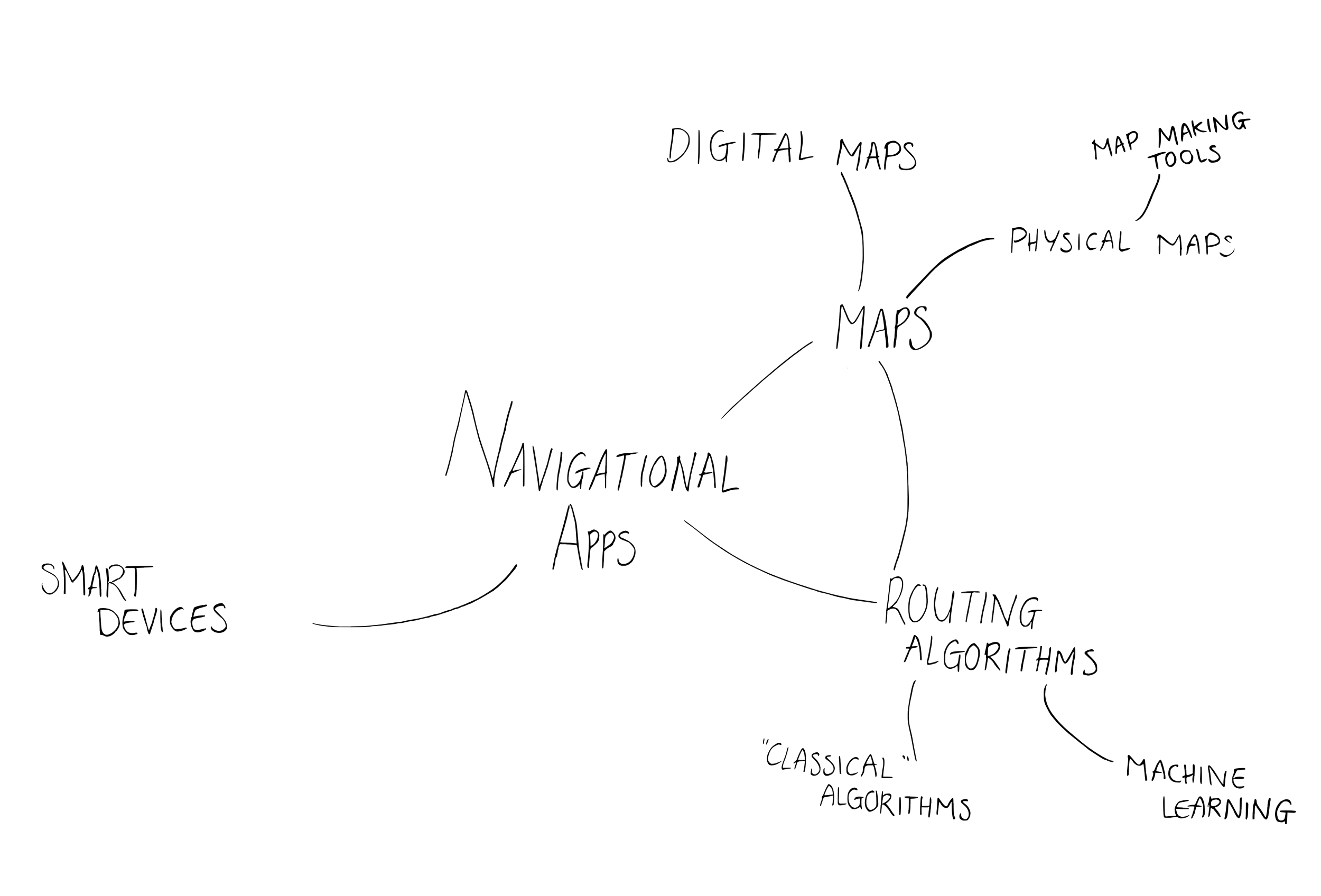
My plan now is to combine the ideas, analyses and experiments I have performed to finally come to an analysis of navigational apps themselves. Now I am doing this for less than one day a week, let’s hope I make it before self-driving cars have taken over our roads and have made this all obsolete. So without further ado, let’s dive into chapter 1: MAPS.